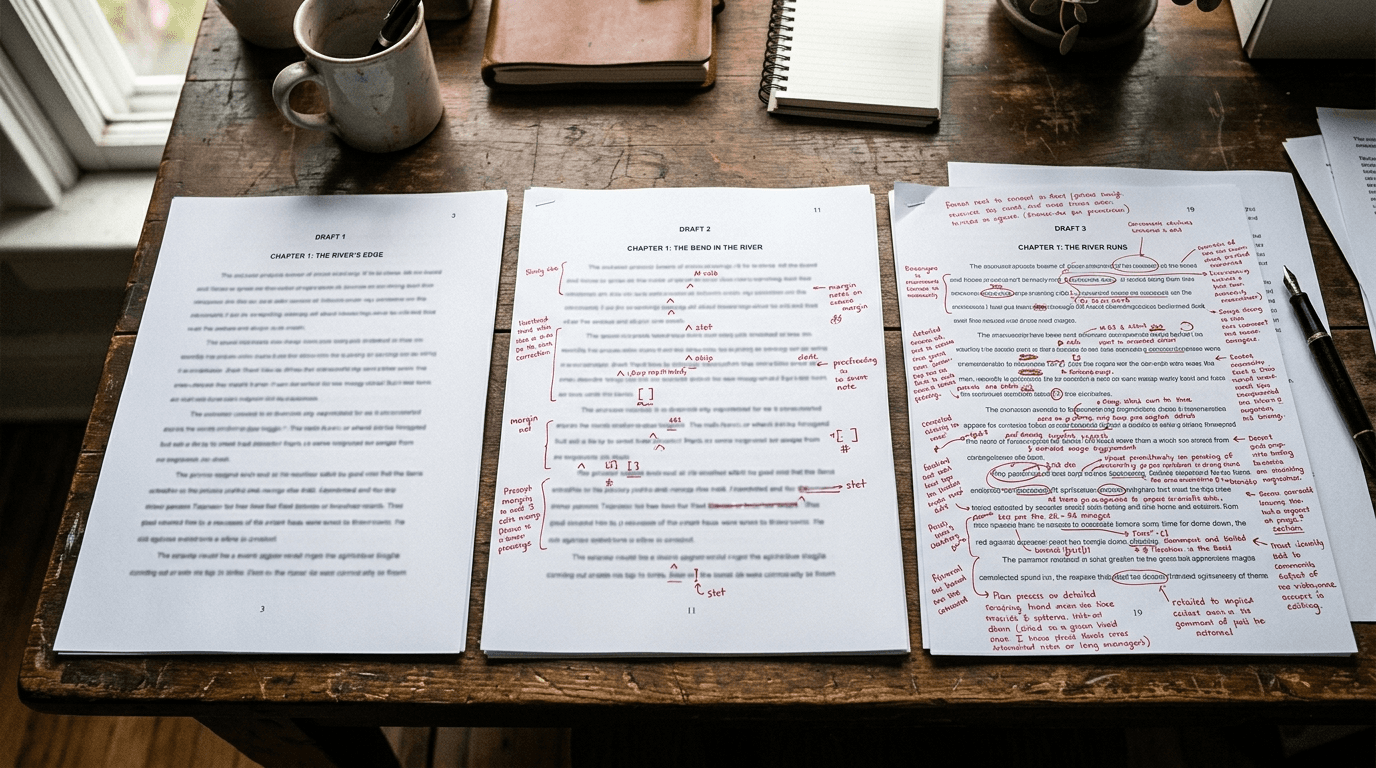
The first review pass you set up will catch the obvious failures. At 10 articles a month, that’s enough. At 50, the pass itself becomes the bottleneck, and the subtle failures, the ones that don’t announce themselves in draft review, accumulate quietly in your index.
Three-pass review isn’t a premium QA workflow for overcapitalized content teams. It’s the minimum viable architecture for consistent output at scale. Here’s what each pass is actually doing, who owns it, and what artifacts it produces.
Why Single-Pass QA Breaks at Scale
I’ve watched this at several agencies: strong editors, rigorous voice guidelines, and a review queue that holds at 5 articles per week. The moment production scales past 15–20 articles weekly, the queue becomes the bottleneck. Editors compress reviews. Compressed reviews collapse into structural checks: does this cover the brief?
The structural problem is that a single review pass conflates three distinct failure modes: coverage failures (the article doesn’t answer the brief), drift failures (voice degrades past a certain length), and register failures (the prose reads as AI-generated regardless of voice guidelines). Conflating these means you either over-review everything, unsustainable at scale, or miss the failure modes that are hardest to catch in a fast read.
The mistake most content leads make is adding more reviewers to a single pass rather than structuring three separate passes with distinct, non-overlapping scopes. More eyes on the same undefined scope doesn’t improve coverage; it just distributes the same gaps across more headcount.
Pass 1, Coverage Check
The first pass is structural and fast. Its scope: does the article cover the brief? Every section in the outline has a checkmark or a gap flag. Nothing else.
I’ve seen this done two ways at volume: a lightweight coverage matrix the editor works through in under five minutes per article, or programmatic coverage scoring against brief headings. Both work. The programmatic version scales better above 30 articles per week; the manual matrix stays accurate longer because it doesn’t depend on AI-graded relevance. For most teams below 50 articles per week, the manual matrix is faster to deploy and easier to calibrate.
Clearscope’s content grading works as a proxy for Pass 1 if you’re already running it. The weakness: it grades NLP keyword presence, not semantic coverage against your specific brief. The distinction matters when your brief has coverage requirements that don’t reduce to keyword density, which is most briefs above the basic informational format.
Tools: BriefWorks brief export, any structured checklist tied to outline headings.
Artifacts: Coverage report, pass/fail per section with gap flags. Articles that pass move to Pass 2. Articles that fail return to the writer with specific gap flags, not a general “please improve” note. Specificity is what makes revision fast.
Who owns it: Content operations manager or a trained junior editor. The scope is narrow enough to delegate without quality loss.
Pass 2, Voice Fidelity Check
This is the pass most teams skip. The failure mode is invisible until it compounds.
Models trained on public-web text have an inherent pull toward the average of that corpus. In a short article, 600–900 words, a good persona specification suppresses that pull. Past around 1,500 words, the pull reasserts. The voice you specified in your brief gets averaged toward the generic register the model’s weights favor. The article doesn’t become wrong. It becomes bland and unattributable.
I noticed this pattern across a batch of articles in recent work, each one had clean coverage, passed structural review, and still felt like it was written by a different, blander version of the persona specified. The problem wasn’t the writer. It was the architecture: one review pass can’t catch both coverage and voice drift simultaneously.
In our recent observation, a fintech SaaS content team ran a structured comparison across 15 briefs using the same persona spec with single-pass coverage review only. Sections 1–3 matched the persona reliably. Sections 4 onward drifted toward what we called “anonymous LinkedIn”, confident declaratives stripped of any voice marker, the kind of prose that could have been written by any model on any brief. The drift appeared consistently past the 1,500-word mark across their entire batch, not randomly.
Pass 2 scopes to voice only. Its checklist:
- Does the opener match the persona specification?
- Do sections 1–3 maintain the specified register?
- Do later sections show drift toward generic AI register?
- Are persona-specific rhetorical moves present throughout, or only in early sections?
If your current content brief contains a tone section that reads “Professional, authoritative, and engaging,” your Pass 2 is running blind. The voice reviewer has no checkable reference. They’re reading against a vibe, not a specification.
A proper voice spec for Pass 2 purposes contains: required rhetorical actions (things the prose must perform in every section), a banned phrase list (not synonyms, the literal phrases), and example sentences that demonstrate cadence, not just topic. That’s the difference between a specification you can audit and a tone instruction you can only feel.
Tools: Persona specification doc. Not a tone slider, a structured spec with required rhetorical actions, banned phrases, and example sentences. The voice reviewer works against the spec, not against a vague adjective.
Artifacts: Drift report, per-section voice grade plus specific flagged sentences. Pass 2 failures return to the writer with the drift map: here are the sections that slipped and the sentences that triggered the flag.
Who owns it: Senior editor or content director. Voice judgment requires the context the spec provides, but it can’t fully replace editorial experience.
Pass 3, Cross-Model Adversarial Review
The third pass does something neither a human editor nor the generating model itself can do reliably: read the article as an adversary would.
I’ve seen human editors miss AI register markers because their reference point is the current article, not the full distribution of AI-generated prose. A critic running on a different model family reads the article cold, without the framing that the generating model brings. It catches what the generating model is blind to because they share the same training distribution.
The practical setup: if you generate with GPT-4o, your critic runs on Claude or Gemini, and vice versa. The critic doesn’t generate replacement prose. It flags specific sentences or sections that read as AI-generated prose by the standards of the target audience, with a short rationale for each flag. That output is a revision target for a final human edit.
What it catches: Generic transitions (“This is why…”, “With that in mind…”), summary sentences that restate the previous paragraph, symmetrical paragraph structure across multiple sections, and phrase-level tells that pattern-match against trained-AI register. None of these are individually wrong. Their density is the signal. The same density signal that flags AI register in published content also predicts ranking decay, posts with high AI-register density tend to underperform in sustained organic traffic within 90 days of publish.
Tools: Adversarial critic prompt running on a different model family from the generator. A smaller but distinct model catches more than the same large model reviewing itself.
Artifacts: Critic report, flagged sentences plus rationale. Reviewed in batch by the content director. The goal isn’t zero flags; it’s reducing flag density below the threshold a fast-reading audience member would catch.
Who owns it: Automated, the critic pass runs without human input and produces structured output for human review. The content director reviews the critic report, not the full article.
The Full Stack: Who Runs What at 50+ Articles/Week
Three passes sounds like three times the review overhead. In practice, Pass 1 and Pass 3 are fast and partly automated. Pass 2 is the true bottleneck, voice judgment doesn’t compress well.
At 50+ articles per week, the architecture I’ve seen hold up:
- Pass 1 (coverage), junior editor plus structured checklist, roughly 5 minutes per article
- Pass 2 (voice fidelity), senior editor, up to 15 minutes per article focused on drift markers rather than a full read
- Pass 3 (adversarial), automated critic run, output reviewed by content director in batch
Active editor time: under 25 minutes per article. The alternative, one senior editor doing a full unstructured review, runs 30–45 minutes per article and catches fewer failure modes because the scope is undefined. More time, less coverage of what actually degrades ranking performance.
What this changes for your brief workflow: each pass requires a different artifact from the brief phase. Pass 1 needs a structured coverage checklist derived from the outline. Pass 2 needs a persona specification with explicit required rhetorical actions. Pass 3 needs an adversarial prompt and a model family that isn’t your generator.
If your brief currently has a tone field with adjectives, you have the inputs for Pass 1. You don’t have the inputs for Pass 2. That’s where most AI content programs leak quality, not in generation, but in the review infrastructure that can’t catch what the generation phase does wrong past the 1,500-word mark.
The data on what actually drives durable rankings in 2026 supports the same conclusion: structural quality signals, not length, not keyword density, are the differentiating factor at the volume content programs AI is capable of. A three-pass review is the operational architecture that produces those signals consistently.
BriefWorks generates the coverage checklist from the brief outline, enforces a voice specification at the brief phase rather than a tone slider, and runs an adversarial review pass before article delivery. If you’re managing AI content at volume and your current review is a single read-before-publish gate, the three-pass architecture is the starting point, not a stretch goal.
FAQ
How long does a three-pass review take per article at scale?
Pass 1 (coverage) runs roughly 5 minutes per article with a structured checklist. Pass 2 (voice fidelity) takes up to 15 minutes focused on drift markers rather than a full read. Pass 3 (adversarial) is automated and produces a report reviewed in batch by the content director. Total active editor time is under 25 minutes per article, comparable to a single unstructured senior-editor review, but with better separation of failure modes.
At what volume does single-pass review break down?
Single-pass review typically holds until around 15–20 articles per week. Past that threshold, editors compress review time. Compressed reviews default to coverage checks and miss voice drift. The failure isn’t the editors, it’s the scope: one pass can’t simultaneously audit coverage, voice fidelity, and AI register.
Why does voice drift appear past 1,500 words?
Models trained on public-web corpora have statistical weights that pull toward the average of that corpus. A strong persona specification suppresses that pull in shorter output, but in longer pieces the model’s base weights reassert. The result is prose that started in your specified voice and reverts toward a generic register in later sections. Drift is measurable per-section, it appears consistently in sections 4+ rather than randomly across the article.
What’s the difference between a tone instruction and a voice specification?
A tone instruction tells the model how to sound: “professional and authoritative.” A voice specification tells it what to do: required rhetorical actions each section must perform, a banned phrase list, and example sentences that demonstrate cadence. Tone instructions are unauditable, you can only feel whether they worked. Voice specifications are auditable: you can check whether the required moves are present and whether the banned phrases appear. Pass 2 requires the latter.
Does the adversarial pass need a different model, or can the same model review its own output?
The same model reviewing its own output misses the register markers it can’t see from inside its own training distribution. A critic running on a different model family reads the article without the context and framing that shaped the generating model’s output. That cold read is what surfaces the tells. A smaller but distinct model catches more than the same large model reviewing itself.