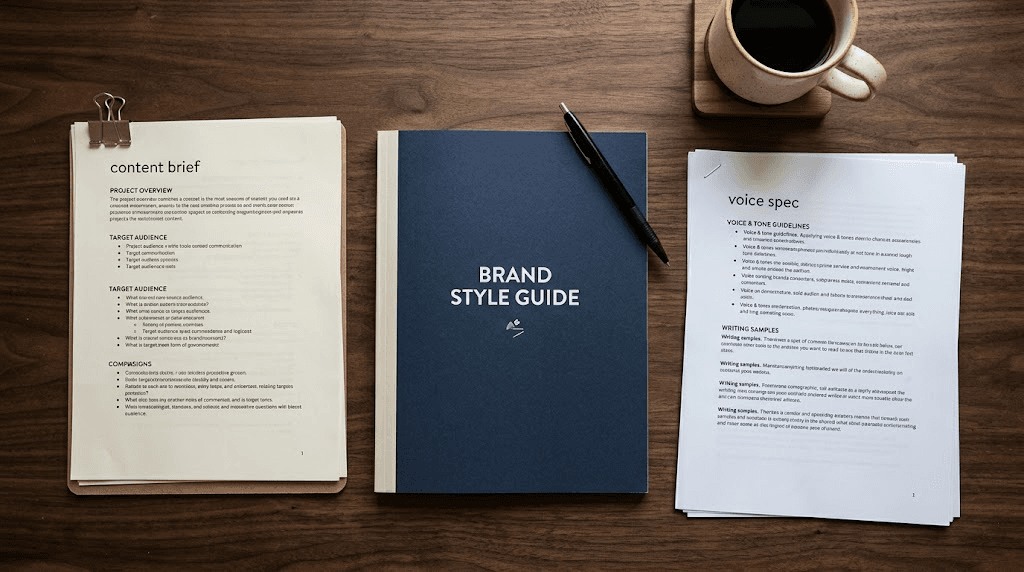
A content brief is a document that defines the objective, audience, SEO requirements, tone, and structure of a piece of content before a single word is written. It gives writers everything they need to produce the right piece the first time, without back-and-forth, without revision spirals, without keyword fixes after publish.
At its core, a content brief answers nine questions:
- What is the topic and target title?
- Who is the target audience?
- What are the goals and purpose of this piece?
- What SEO requirements must it meet?
- What structure and outline should it follow?
- What tone and style should it use?
- What references and sources should it draw from?
- What call to action should it include?
- Who approves it, and when?
Get those nine questions answered before writing starts, and you eliminate most revision cycles before they begin. Miss even two of them, and you’ll feel it in the edit.
Why Content Briefs Are Worth the Upfront Time

Most revision cycles are not about quality. They’re about misalignment.
A writer submits a 1,400-word listicle. The editor wanted a 2,600-word how-to guide. The SEO lead notices the target keyword appears twice, both times in the last third. The brand manager flags a tone that’s too casual for the enterprise audience. Every one of those is a brief failure, not a writing failure.
The case for briefs is quantitative. Content teams that brief consistently report:
- 50–60% fewer revision rounds per piece
- 20–30% faster production cycles from assignment to publish
- First-draft approval rates above 80%, versus an industry norm below 40%
The upfront cost is real. A thorough brief takes 30–60 minutes to write. The return, eliminated revisions, zero post-publish keyword fixes, shorter stakeholder review cycles, routinely saves 2–4 hours per piece. For a team producing 20 pieces a month, that’s the equivalent of one full-time writer’s monthly output recovered from administrative overhead.
The cost nobody tracks
There is a cost that does not appear in any content audit: articles that rank poorly because the brief was vague. When the writer does not know the search intent, they produce content that satisfies neither the user nor the algorithm. Brief quality correlates directly with ranking performance, but most teams treat the brief as a five-minute formality.
Briefs also serve as institutional memory. When a contractor or new hire joins your team, a library of well-structured briefs is faster to onboard from than any brand guidelines document.
The 9 Components of an Effective Content Brief
These nine components map to what industry consensus, and Google’s AI Overview, identifies as the standard content brief structure. The ninth component, governance and approval, is what most guides leave out. It is also the one most responsible for revision spirals in teams larger than two people.
1. Topic & Title
Include the exact topic and two to three title options. For SEO content, also include:
- Working title, what you’d pitch in a planning meeting
- SEO title options, optimized for keyword placement and click-through rate
- Primary keyword, the exact phrase the title must contain
A clear title constraint prevents the most common brief failure: the writer optimizes for a slightly different keyword than intended, and nobody notices until the article is indexed.
2. Target Audience
Specify the reader with enough precision that a writer who has never spoken to your customer can make the right judgment calls. Include role, knowledge level, goal on this page, and who the piece is not for. The audience definition controls tone, assumed vocabulary, depth of explanation, and which examples land.
3. Goals & Purpose
State goals explicitly: traffic goal, conversion goal, brand goal, and funnel stage. Goals determine how aggressively the piece should sell, how much space the CTA deserves, and what “performing well” looks like twelve months from now.
4. SEO Requirements
Include: primary keyword (in H1 and within the first 100 words), secondary keywords, long-tail / FAQ targets, internal links both directions, external sources to cite, target URL slug, meta description, and target word count based on SERP analysis, not an arbitrary round number. For the deeper SEO-specific component (GEO requirements, schema, AI Overview targeting), see our SEO content brief guide.
5. Outline
All H2 sections with a 1–2 sentence description of what each must cover, H3 subsections where hierarchy matters, target word count per section, and notes on what to include or explicitly avoid. The outline is not a constraint on creative expression. It is a time-saving contract.
6. Tone & Style
“Professional but conversational” tells a writer nothing. Give them: a formality scale (1–5 with examples), perspective (you/we/they), vocabulary to use and avoid, and reference articles that match your target register.
7. References & Sources
Provide competitor articles to differentiate from, research and data to cite, internal assets to reference, and a list of competitor pages not to link to. Do not leave source research to the writer. They will find random sources, you need them to find your sources.
8. Call to Action
Specify the exact CTA text, destination URL, any secondary CTAs with priority order, and placement guidance. Ambiguous CTAs produce weak closes. A specific CTA in the brief produces a specific, confident close in the article.
9. Governance & Approval
Document: who approves the brief before brief-out (one name, not a committee), who reviews the draft (SEO and editorial separately), revision limit, version control, and the full deadline chain. Without a documented approval chain, every article is one unclear stakeholder away from a three-week stall.
Content Brief Templates for Every Content Type

Most guides default to blog templates only. Video scripts, social campaigns, and influencer partnerships fail because teams apply a blog brief template to content types it was not designed for. Here are four ready-to-use templates.
Blog Post Brief Template
TOPIC & TITLE
Working title:
SEO title options (3):
Primary keyword:
URL slug:

AUDIENCE
Role / persona:
Knowledge level:
Goal on this page:
Who this is NOT for:

SEO
Primary keyword:
Secondary keywords (3–5):
Long-tail / FAQ targets:
Internal links from:
Internal links to:
Meta description:
Target word count:

OUTLINE
H2: [Section title], [what it covers], [word count]
  H3: [Subsection]

TONE
Formality (1–5):
Perspective:
Vocabulary to use / avoid:
Reference articles:

CTA
Primary CTA text:
Destination URL:
Placement:

GOVERNANCE
Brief approved by:
Draft reviewer (SEO):
Draft reviewer (editorial):
Revision limit:
Publish date:
Video Script Brief Template
VIDEO BRIEF
Platform: YouTube / LinkedIn / Instagram / TikTok
Target runtime:

HOOK (first 15 seconds)
Problem the hook states:
What the viewer gains by watching:

STRUCTURE
Hook / Intro, [:XX]
Section 1: [topic], [:XX]
CTA / Outro, [:XX]

TONE
On-camera energy: calm / enthusiastic / authoritative
Vocabulary: technical / accessible

VISUALS
B-roll notes per section:
Product demo: yes / no

CTA
Verbal CTA:
Description link:
Social Campaign Brief Template
SOCIAL BRIEF
Formats: LinkedIn post / carousel / Instagram Reel / X thread
Publish dates:

GOAL
Awareness / engagement / clicks / DMs

AUDIENCE
Who should stop scrolling:
What they currently believe:
What you want them to believe after:

PER-FORMAT SPECS
Hook line (1 sentence):
Body / slides outline:
CTA or comment prompt:
Influencer Brief Template
INFLUENCER BRIEF
Creator handle:
Deliverable: [e.g., 1 × Instagram Reel]
Publish window:

REQUIRED ELEMENTS
[ ] Product name mentioned at least once
[ ] Discount code / link in caption or spoken
[ ] Brand tag + required disclosures

CREATIVE DIRECTION (guidance, not script)
The angle or story we want:
What to show vs. what to say:

GUARDRAILS
[ ] No competitor mentions
[ ] No unapproved pricing claims

APPROVAL PROCESS
Submit draft to:
Revisions allowed:
Final deadline:
How to Write a Content Brief: A Step-by-Step Process

Writing a brief is a research exercise, not a creative one. Do it in this order.
Step 1: Confirm the keyword has an audience. Check search volume and difficulty before writing a line of the brief. A great angle for a topic nobody searches ranks for nothing.
Step 2: Analyze the SERP. Read the top five ranking pages. Note what format dominates, what subtopics appear everywhere, what’s missing everywhere, and which People Also Ask questions go unanswered. The SERP defines the minimum bar.
Step 3: Define your specific audience. A single keyword serves multiple reader types. Pick one and make every choice for them, not all types simultaneously.
Step 4: Write the outline. Include every subtopic the top pages cover (table stakes) and the subtopics none cover (your differentiation). Assign word counts by strategic importance, not page order.
Step 5: Fill in SEO requirements. Write the meta description now. Pull secondary keywords from People Also Ask. Set internal link targets.
Step 6: Set tone with examples. Link to an existing piece that benchmarks the right voice. “Like this piece, not like that one” is usable direction.
Step 7: Define the CTA precisely. One CTA, one destination, one placement instruction.
Step 8: Get one approval before brief-out. SEO lead and editorial lead each review independently, not in a meeting together. Document who approved it and when.
AI-Generated vs. Manual Content Briefs: An Honest Comparison
| Factor | AI-Generated | Manual |
|---|---|---|
| Time to produce | 2–5 minutes | 45–90 minutes |
| SERP analysis | Surface-level (training data) | Real-time, analyst-curated |
| Differentiation quality | Generic, surfaces obvious gaps | Identifies gaps visible only from careful competitor reading |
| Keyword accuracy | Strong on primaries, weak on semantic nuance | Fully controlled |
| Content type range | Typically blog-only | Purpose-built for any format |
| Best for | High-volume informational content, KD under 20 | Pillar content, competitive keywords, brand-critical campaigns |
The recommendation: Use AI-generated briefs as a first draft for informational pieces. Manually review before sending to a writer. For anything competitive or brand-defining, brief it manually, or use a tool like BriefWorks that pulls live SERP data and lets you edit the output. Once the brief is in your writer’s hands, our guide on how to use a content brief covers the writing-side workflow.
Frequently Asked Questions
What should a content brief include?
Topic and target title, audience definition, campaign goals, SEO requirements (primary keyword, secondary keywords, meta description, word count), a section-by-section outline, tone guidance, source recommendations, a defined CTA, and a documented approval chain.
How is a content brief different from a creative brief?
A creative brief governs campaign concept and visual direction. A content brief governs written or multimedia content structure and SEO performance. Creative briefs ask “what should this look and feel like?” Content briefs ask “what should this say, how should it be structured, and what keyword should it rank for?”
How long should a content brief be?
One to three pages for a standard blog post. A brief that runs to five pages is covering what belongs in a style guide. A brief under half a page is an assignment, not a brief.
Who writes a content brief?
Typically the content strategist, SEO manager, or content lead. The writer who executes the piece should not write their own brief, that removes the alignment function the brief exists to provide.
What is the 3-3-3 rule in marketing?
The 3-3-3 rule is a content engagement framework: three seconds to capture attention, three minutes to deliver the core message, three days before the content is forgotten without a follow-on action. Applied to briefs, it informs the hook specification and CTA placement within the first 500 words.
What are the 4 types of briefing?
- Creative brief, campaign concept and visual direction
- Content brief, SEO requirements, structure, audience, and tone for a specific piece
- Editorial brief, lighter-weight assignment format used by publications
- Influencer / talent brief, deliverables, guardrails, and required elements for creator partnerships