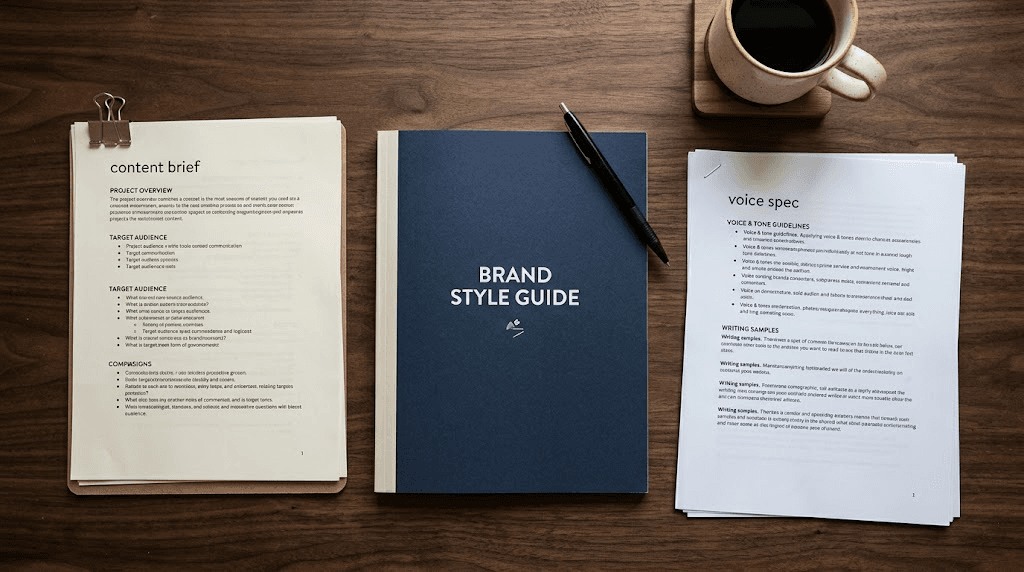
A content brief covers what to write. A style guide covers how the brand sounds. Neither one specifies how to write, which is why AI-authored content sounds like AI-authored content even when the brief is strong and the style guide is thorough.
I’ve said this to content leads at more than a dozen teams over the past three years. The first time, in 2023, auditing the content operation of a Series B SaaS company in London, I expected pushback. Instead I got a long pause, then: “We have both documents. Neither of them is working.”
The problem is structural. Most content teams have two documents where they need three. The missing one is a voice spec: a document that operates at the execution layer, not the brand layer or the assignment layer. It tells a model, or a freelancer, exactly what rhetorical moves to make.
| Document | Answers | Does not answer |
|---|---|---|
| Content brief | What to write, for whom, optimized for which keyword, with which CTA | How paragraphs should open, which phrases signal AI, what the cadence sounds like |
| Style guide | Grammar preferences, product name capitalization, brand vocabulary, formatting rules | Sentence-level rhetorical moves, register tells, model-calibration examples |
| Voice spec | Concrete rhetorical actions, phrase-level ban on AI-register tells, example sentences for cadence matching | Keyword targets, audience definition, brand grammar, those belong in the other two |
What a Content Brief Actually Contains
A brief is an assignment spec. It defines the keyword, the audience, the outline, the SEO requirements, the word count, and the CTA. Done well, it eliminates the main causes of revision: misaligned scope, wrong keyword, wrong audience, missing sections.
What it does not do is specify voice. When you write “professional but conversational” in the tone field, which is what most brief templates say, including every template I’ve ever seen pulled from Notion or Google Docs, you’ve given a writer a vibe, not a spec. “Professional but conversational” could produce anything from a McKinsey partner’s LinkedIn thread to a Y Combinator founder’s Substack post. Both technically qualify.
I watched this break down at a B2B HR software company in 2022. Six freelancers running off the same brief template. Every piece hit every structural requirement. They sounded like six different companies. The brief was fine. The voice spec didn’t exist.
For the components of a well-built brief, our content brief guide covers all nine. For the execution side, what happens once it’s in a writer’s hands, how to use a content brief goes section by section.
What a Style Guide Actually Contains
A style guide governs brand consistency, not sentence-level execution. It specifies: capitalize product names this way, use the Oxford comma, write in US English, avoid jargon from competitor products, no exclamation points in product copy.
Mailchimp’s content style guide is the one most content teams cite as a model. It covers voice and tone, writing for social media, accessibility, word usage, legal considerations, dozens of sections, all thorough. It is a well-constructed document.
If you hand that style guide to an AI model and ask it to write a blog post, you still get generic prose. Not because the style guide is inadequate, it was built for human writers who already know how to write and need brand alignment, not for correcting the training dynamics that make large language models default toward the median of public-web output. Style guides were never designed to do that job. They pre-date it by decades.
The Execution Gap: What Neither Document Covers
AI models trained with human feedback learn to produce output that reviewers find acceptable. Over enough training iterations, this pull toward approval creates writing that is grammatically fluent, inoffensive, and nobody’s voice in particular. A brief tells the model what to write. A style guide tells it what to avoid at the brand level. Neither tells it what rhetorical moves to make every time it opens a paragraph.
The mistake most content operations make is treating voice as a filter, something you enforce at edit time after the draft exists. By then you’re rewriting, not editing. Voice needs to be a spec before the model writes the first sentence.
A voice spec needs three things the brief and style guide don’t have:
- Concrete rhetorical actions the model must perform in every section, observable, verifiable moves, not vibes
- A phrase ban targeting register tells, not brand vocabulary, but the specific phrases that mark AI-generated prose as AI-generated
- Calibrated example sentences showing the specific cadence to match, not “write like Mailchimp,” but three sentences from your own best work that anchor the rhythm
What Makes a Voice Spec Different from a Tone Guide
“Rhetorical actions” sounds abstract. What I mean is moves the model can either perform or fail to perform, moves a reviewer can check. Not “be conversational.” That is a vibe. “Open at least one paragraph per section with first-person experience” is a verifiable instruction. Either the draft does it or it doesn’t.
The phrase ban in a voice spec targets a different register than the brand-level phrase ban in your style guide. Your style guide probably says “don’t use ‘synergy.’” A voice spec’s phrase ban targets the tells that make AI output recognizable as AI output, phrases that appear in machine-generated prose at rates measurably higher than in strong human-authored work of comparable length. We run a programmatic check against these at draft time; the filter catches register drift before it reaches an editor.
Then the example sentences. Not “write like Paul Graham” or “match the Mailchimp voice”, those are approximations of someone else’s brand, not yours. Three sentences calibrated to your brand’s actual cadence: an opener, a declarative in the body, a closer. Concrete anchors the model can pattern-match against, not aspirational comparisons to another organization’s archive.
The Three-Document Stack
Content brief. Style guide. Voice spec. Each covers a distinct layer, and the layers don’t overlap.
The brief covers the assignment: keyword, audience, outline, CTA, SEO requirements. The style guide covers the brand: grammar preferences, vocabulary rules, product-name formatting, tone descriptors. The voice spec covers the execution layer: how to open a paragraph, which phrases mark the prose as machine-generated rather than human, and what the cadence sounds like in calibrated examples.
Missing any one creates a predictable failure. Without the brief, you get drift, content that wanders from the objective. Without the style guide, you get inconsistency, six freelancers producing six brands. Without the voice spec, you get slop, technically compliant content that reads like the median of the internet.
For teams producing AI-assisted content at volume, the voice spec is what determines whether output is publishable at edit time or requires a full rewrite. The SEO content brief guide covers the keyword and SERP layer of the stack. The voice spec sits on top of that, it operates at the generation layer, not the planning layer.
Building a Voice Spec Without Starting from Scratch
The fastest path is audit-first. Pull your five best-performing pieces from the past twelve months, pieces that sound like your brand and produced results. Read each one for repeating moves. What does your best writer do in the first paragraph of every section? What phrases do they never reach for? What does a typical sentence look like in the middle of a body paragraph?
Those observations become your rhetorical actions, your phrase ban, and your example sentences. You’re not inventing a voice. You’re documenting the one that already works.
In early 2024, I spent a week on exactly this with a fintech content team. They had a brief template from 2021 and a style guide that ran to 60 pages. Their AI drafts kept missing, too formal in patches, too casual in others, consistently reaching for “ensure” and “utilize” in ways their strongest human writer never did. We spent the week pulling their archive, not building a spec from first principles. The resulting voice spec was two pages. The register problem was fixed in the next batch of drafts.
For a broader look at what content structure actually correlates with ranking performance, which feeds into brief design upstream of the voice layer, our 2026 ranking pages analysis has the structural data.
Frequently Asked Questions
What is the difference between a content brief and a style guide?
A content brief is an assignment spec for a single piece of content: keyword, audience, outline, SEO requirements, CTA. A style guide is a brand consistency reference: grammar rules, vocabulary preferences, product name capitalization, tone descriptors. A brief tells a writer what to produce. A style guide tells them how to stay on-brand. Neither specifies the sentence-level rhetorical moves that determine whether the prose sounds like a human author or like a generative model.
Can I update my style guide to do what a voice spec does?
You can add sections to a style guide, but the containers serve different functions. Style guides are designed for human writers who already produce acceptable prose and need brand alignment. A voice spec is designed to specify execution-layer behavior: verifiable rhetorical actions, a phrase-level ban on AI-register tells, example sentences calibrated for model pattern-matching. Mixing these into a style guide tends to produce a document that does neither job well. Keep them separate.
Does a voice spec help human writers, or just AI models?
Both. The rhetorical actions are checkable by any writer. The phrase ban is useful in a final-pass read. The example sentences work as calibration anchors for contractors, new hires, and anyone who hasn’t internalized your brand register over years. In practice, senior writers on long-standing teams tend to hold this spec in their heads, the document makes it explicit for everyone else.
What is the difference between a voice spec and a tone guide?
Tone guides describe an outcome: “professional,” “warm,” “authoritative.” A voice spec describes the actions that produce that outcome. The difference matters because a model cannot execute “be warm”, it can execute “open each section with a first-person sentence.” Tone guides tell you where you’re trying to land. The voice spec tells you how to get there.
How long should a voice spec be?
One to two pages. A spec that runs longer is likely covering territory that belongs in the style guide. The voice spec is the distillation of your brand’s execution fingerprint: five to eight rhetorical actions, a phrase ban of 20 to 40 items, and three calibrated example sentences. If you need substantially more than that, the voice hasn’t been decided yet, which is a different problem to solve before writing any spec.