Voice drift (the gradual regression of AI-generated prose toward the statistical average of public-web content) does not happen in section 1. It happens in section 4. Your opener sounds specific. Your second section holds. By the third H2, you are reading sentences that could have come from any AI tool published last week. This checklist is the systematic scan that catches that before it ships.
Standard review catches grammar errors and obvious clichés. It does not catch the five failure modes that make AI content feel generic even after a grammar pass. Those require a different kind of scan, specific, section-level, run before the article is considered done.
The checklist below covers every check in order. Use it per section, not end-to-end.
What voice drift is, and why it always ends up in the same place
RLHF (reinforcement learning from human feedback) is the training process that shaped most production AI writing tools. It optimizes model output toward what human raters positively evaluated, and those raters’ judgments were shaped by high-engagement public-web content: marketing blogs, ranked how-to articles, editorial content from 2020–2024. The model learns to produce prose that resembles the median of that corpus.
Voice drift is what happens when a piece stops matching the persona it started with and starts matching that median. Consider: take any 3,000-word article generated with a persona specification. Read section 1 against the spec. Now read section 4. The vocabulary will have converged. Sentence lengths will have equalized. The persona’s opener patterns will have vanished.
The persona specification (the voice definition you gave the model at the start) exerts the most pressure during generation’s first pass. Past roughly 1,500 words, in our analysis, this is where drift becomes measurable, the model’s defaults reassert. This is not a failure of the spec. It is how attention works in large language models: early-context constraints diminish in influence as the generation window fills.
Voice drift is a mechanical outcome of how these models generate long text, not a content-quality judgment call.
Five failure modes that survive a grammar pass
These five do not register as errors. They look fine in a grammar check. They are wrong.
Opener preamble
Preamble (a sentence or paragraph that announces what the article is about to do instead of doing it) is the most common first-section failure. “In this guide, we’ll cover...” or “If you’re looking to understand X, you’ve come to the right place”, grammatically correct, editorially empty. They exist because AI models default to framing before asserting.
Register leakage
Register (the vocabulary and cadence patterns that signal AI authorship regardless of topic) survives a grammar pass because register is not a grammar category. “Leveraging,” “navigate the landscape,” “game-changer,” “cutting-edge”, these appear in AI-generated content regardless of persona spec because they were reinforced by the same training signal that creates drift. A grammar pass will not find them.
Structural filler
A filler section exists because the outline demanded an H2, not because it answers a specific query. The diagnostic: write the search query this section answers in the margin. If you cannot name the query, the section is filler. AI systems fill outline slots by default; they do not validate whether each slot resolves a user question.
Vague entity use
e.g., “many companies use this approach,” “some experts suggest,” “a leading brand in this space.” These appear when the model lacks training data for a named source and does not flag the gap. They pass every grammar check and fail every credibility check.
Flat cadence past section 3
Sentence length and structure equalize in the second half of AI-generated articles. Short declaratives give way to medium-length compound sentences. The rhythm becomes uniform. No grammar error, no banned phrase, just the wrong cadence for the established voice. Readers do not identify it as drift; they simply disengage.
A grammar pass and a cliché scan are prerequisites, not a review. These five are what an actual review catches.
The 10-point AI content review checklist
Run this per section, not once across the full article. Drift accumulates, a section that almost passes will influence the next one. One section at a time, in order.
Opener (apply to section 1 only)
- First sentence is a direct claim. Not a question, not an announcement, not a definition-opener. A claim. “Voice drift happens in section 4” is a claim. “In this article we’ll explore voice drift” is not.
- No preamble. Cross out the sentence “In this guide...” and check if the section still makes sense. If yes, the sentence was preamble. Cut it.
Register (apply every section)
- No AI-register phrases. Scan for: leveraging / seamlessly / game-changer / cutting-edge / deep dive / navigate the landscape / rapidly evolving / it’s worth noting / ultimately / a wide range of. If any match, rewrite the sentence, not the phrase, the sentence.
- No simulated-candor hooks. “I’ll be transparent,” “let me be honest,” “real talk”, replace each with the specific statement the hook was covering. Demonstrate; do not announce.
Voice fidelity (apply every section)
- Sentence length varies. If three consecutive sentences are the same approximate length, break the pattern. One short. One long. Alternate.
- Persona vocabulary appears in this section. Each section should contain at least one sentence whose cadence matches the persona’s example sentence. If the example is “I’ve watched six teams ship this and three failed at the same handoff,” a section of passive-voice compound sentences is drift.
- No parallel triplets. “X, Y, and Z” in a single parallel clause is an AI default rhythm. Break the list across sentences, or restructure to two items with expansion.
Factual claims (apply every section)
- Every specific number has a source. A linked citation, or a clear “in our analysis” qualifier. No bare percentages, no “studies show.”
- Entity references are named. “Many companies” → name one. “Some experts” → name the study or the expert. If you cannot, soften the claim or cut it.
Structure (apply every section)
- This section answers a specific query. Write the query in the margin before checking. If you cannot write it, the section is filler. Restructure or cut.
Each item is binary. Pass or fix. There is no partial credit.
How to apply this without slowing your workflow
The checklist takes roughly four minutes per section on a 500-word H2 block. For a 2,500-word article, that is a 20-minute review pass. The expensive part is not the checklist, it is the revision round that fires because the review did not happen.
Run items 1–2 on section 1 only. Run items 3–10 on every section in order. Fix failures before moving to the next section. Do not read ahead.
Take a recent article generated without this pass. Open section 4 specifically. Count how many sentences have identical lengths. Check for one parallel triplet. Check for one vague entity reference. In our analysis of common failure patterns, two of those three checks will fail in the fourth section of almost any unreviewed long-form AI piece. That is not a coincidence, it is the drift window.
The reason this is a per-section tool rather than an end-to-end pass is the same reason blog monitoring works at the URL + query level rather than the domain level: aggregate signals mask section-level failures. A 3,000-word article that “reads fine” has two failing sections somewhere. The per-section pass finds them.
For AI-generated content past 1,500 words, budget one review pass per 500-word block. Voice drift and register leakage cluster in the second half, the same structural misalignment that the zero-volume search demand framework describes at the query level applies here at the sentence level: the gap between what the spec demanded and what actually shipped widens over length.
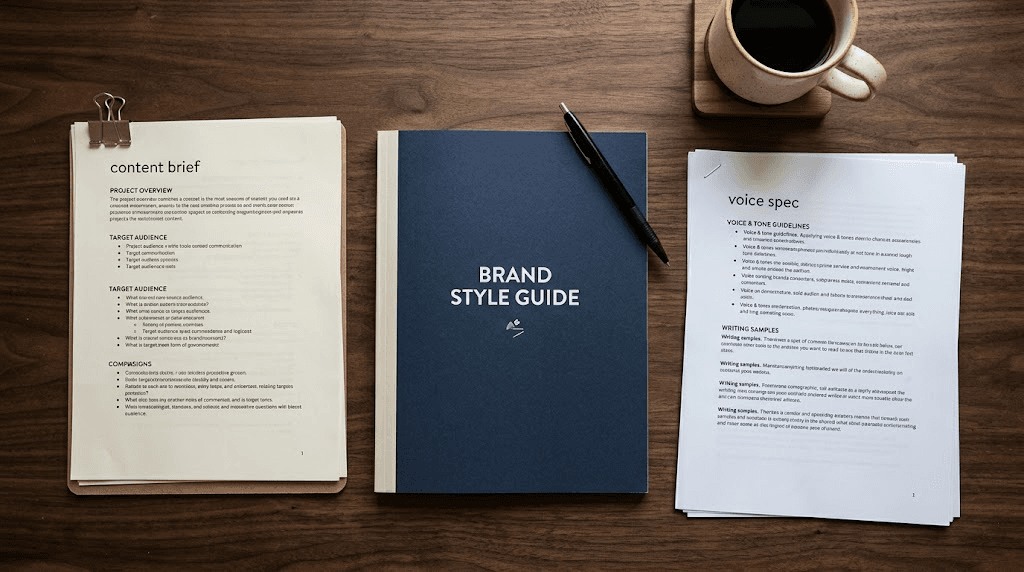
Item 10, “does this section answer a specific query?”, is the one most reviewers skip. Answering it requires knowing what queries the article targets. That means having the content brief in hand during review, not just the draft. A review without the brief is a copy-edit. This is a content audit.
For teams generating at volume, consider building this checklist as a prompt layer between generation and publication: a separate model pass running items 3–10 programmatically before the draft reaches a human reviewer. The query fan-out model of AI search evaluates content at the section level for citation eligibility, your review pass should operate at the same granularity.
Frequently Asked Questions
How is this different from running an AI detection tool?
AI detection tools (e.g. GPTZero, Originality.ai) score the probability that text was AI-generated. This checklist does not care whether the text was AI-generated, it checks whether it reads like it was. A human writer who has absorbed AI-generated content extensively can produce prose with the same register failures. A well-reviewed AI article passes this checklist and most AI detectors. The checklist targets output quality, not provenance.
Should I run this on every article or only long-form?
Run items 3, 5, 7, and 9 on every AI-generated piece regardless of length. Those four checks catch register leakage and vague entity use, failures that appear in 500-word pieces as readily as in 3,000-word ones. Run the full 10-item pass on anything over 1,000 words, since items 1, 6, and 10 require structural evaluation that is not meaningful below that length.
What’s the most commonly failed check?
Item 9 (named entities) and item 7 (no parallel triplets) fail most frequently in our analysis. Vague entity use is the harder one to catch, the phrases are grammatically correct and stylistically neutral, so “many organizations have found” reads like normal editorial prose. Parallel triplets are easier to spot once you know to look, but they appear in nearly every AI-generated first draft.
Does voice drift happen in human-written content too?
Yes, specifically in human-written content that draws heavily on AI-generated research or outline drafts. The writer absorbs the register of the source material. The fix is the same: run items 3 and 6 against the persona spec before submission. The pattern of failure is identical; only the mechanism differs.
How often should this checklist be updated as AI models change?
Items 1, 2, 5, 7, and 10 are structural checks that do not depend on which model generated the text, they will not need updates. Items 3 and 4 (register phrases and simulated-candor hooks) evolve as models are updated and new register patterns emerge. Review the phrase list in item 3 quarterly, particularly after major model version releases. The SERP evolution data from 2026 shows that content structure requirements shifted significantly between model update cycles, register patterns move on a similar timeline.