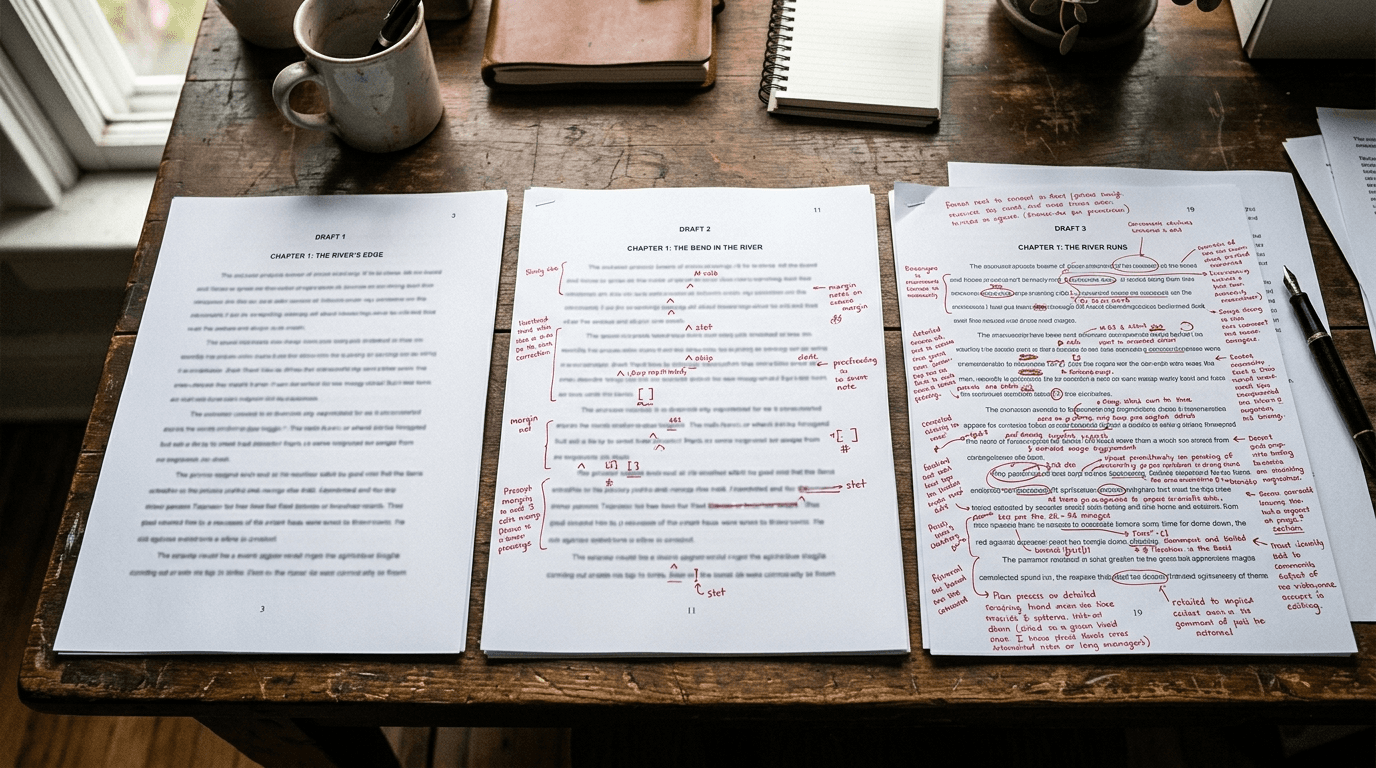
Run any frontier LLM through a 2,500-word article draft and watch what happens to the voice. The opening section is usually competent, sometimes genuinely sharp. By section 6, it has softened. Hedges appear. Sentences go passive. The specific, opinionated prose from the first 400 words has been replaced by something that reads like the median business blog post. Which is to say: like nothing in particular.
This is not a prompting problem. A longer persona description doesn’t fix it. More examples don’t fix it. Stricter instructions don’t fix it. The drift is structural, and it traces to a specific property of how these models are trained, one that no amount of system-prompt engineering fully overrides.
The Mechanism: RLHF and the Pull Toward Average
Reinforcement learning from human feedback (RLHF) trains language models to produce outputs that human raters prefer. Human raters consistently prefer text that reads as clear, balanced, and cautious. That profile is not your brand voice. It is the statistical average of well-formatted public-web prose.
A 2025 arXiv study on the effects of RLHF on writing quality and detectability found that RLHF fine-tuning produces measurably less diverse output compared to base-model generations, the human-preference signal homogenizes the distribution. Separately, a 2026 study on how LLMs distort written language found that LLM assistance produced a nearly 70% increase in essays that remained neutral on their topic question. The model’s presence pulled writers toward the center. Not through bad prompting. Through exposure to a system optimized for inoffensive centrism.
This is the baseline your article generation inherits. The model starts writing with whatever voice constraints you inject at the top of the context, persona rules, example sentences, banned phrases. It pattern-matches against those for the first few sections. Past roughly 1,500 words, the ratio of generated prose to persona specification in the active context shifts. The trained defaults are a much larger attractor than your system prompt. The model regresses toward them.
The “1,500-word wall” framing survives because nobody publishes the regression data. (We aren’t publishing ours either, internal, not peer-reviewed, treat as directional.) But the pattern is consistent enough that we designed the generation pipeline around it rather than assuming better prompting would close the gap.
What the Drift Looks Like in a Real Generation
The decay isn’t loud. That’s what makes it hard to catch without a systematic check.
Here is an anonymized example from our generation logs: an article on B2B SaaS migration, persona specified as a direct, skeptical practitioner. Paragraph 1 opens with a first-person claim, names a specific year, uses a fragment for emphasis. Three of the four required rhetorical actions for that persona are present in the first 120 words.
Section 6, implementation risks, opens with: “There are several important factors to consider when approaching this phase.” No fragment. No named entity. No first-person. Passive opener. The persona specification is still in the context window. The model stopped following it.
The word count where this pattern became consistent in our logs: just past 1,500 words. Before that, voice holds reasonably well. After that, the decay rate increases. By 2,500 words, the average section has the voice fidelity of an unspecified prompt, not broken, not obviously wrong, just stripped of everything that made it distinctive. The generic-professional drift that every experienced content editor recognizes and every automated coverage checker misses.
Two things the commonly cited fixes won’t address. First: the model didn’t “forget” the persona. It’s still attending to it. The problem is that the training signal is a much stronger prior than the in-context voice spec, and as more generated text fills the context, that prior asserts itself. Second: this is not a capability failure of Sonnet specifically. Every frontier model trained with RLHF has this property to varying degrees. The same mechanism, preference data homogenizing toward careful, neutral output, is present in all of them. The models that drift less on voice aren’t better; they just have different distributional biases.
The Coverage Trap
Most AI writing tools evaluate generated content against a coverage checklist: did the article cover the required topics? Did it include the target keywords? Did it meet the word count? Those are the right checks for a content brief. They are not the right checks for voice fidelity.
The claim that AI writing tools include a review pass survives in vendor marketing because coverage review is trivial to automate and voice review is not. Checking whether section 3 mentions a keyword is a string match. Checking whether section 3 still sounds like the persona defined at the top of the prompt requires a model to hold the persona specification in working memory and compare the section against it, which is exactly the task that degrades past 1,500 words. You can’t use the same mechanism to both generate the drift and catch it.
The result is a systematic failure mode: the review pass confirms the article covered the brief, the article ships, and no one catches that it sounds like every other output from every other AI content system. The coverage pass creates confidence that voice drift has been reviewed when it hasn’t been reviewed at all.
The distinction matters for ongoing content monitoring too. Coverage decay and voice decay are different failure modes. Coverage decay is detectable with query coverage tools. Voice decay is not, it requires a different instrument, one that evaluates rhetorical execution rather than topical inclusion. Teams that track only coverage are flying blind on the signal their audience actually registers.
A Review Architecture That Catches It
The BriefWorks generation pipeline was built around a specific diagnosis: coverage review and voice review are different tasks that need different checkers. Running one pass that tries to do both produces mediocre performance on each.
The pipeline has three passes. Pass 1 is the writer: section-by-section generation against the brief and persona specification. Standard generation, full context window, nothing unusual.
Pass 2 is the voice-fidelity editor. A separate model call, same model family, clean context, but now configured as an editor rather than a writer, receives the full generated draft plus the persona specification and the explicit list of required rhetorical actions. The editor’s scope is narrow by design: are the required actions present across the article? Does the sentence cadence hold past section 3? Are persona-specific banned phrases absent? The editor does not touch coverage or keyword inclusion. Those were the writer’s job and were already confirmed.
The editor returns a structured verdict. If it finds no drift, the article exits after two passes. Clean generations are common, roughly half of first drafts in our pipeline pass the voice editor without corrections. (Small sample, internal, treat as directional.) If the editor finds drift, it flags specific sections and specific failures: which required action was missing, which sentence opened the wrong way, which phrase slipped through the banned list.
Pass 3 is conditional: it fires only when the editor returns findings. The retry prompt is explicit about what failed and why. Not “rewrite with better voice.” Specific failures, specific corrections: “Section 6 lacks a named entity; section 8 opened with a transitional adverb the persona prohibits; regenerate both with the following adjustments.” The corrected sections are then spliced back into the full draft rather than regenerating the entire article.
The conditional structure matters for cost. Most generations that drift do so in 2–4 sections, not uniformly. Regenerating the entire article for 3 drifted sections is wasteful. The targeted retry keeps cost proportional to the scope of the actual problem.
The same principle that motivates structured query fan-out in brief generation applies here: explicit structural checks beat hoping the model maintains context. Whether you’re ensuring a brief covers all intent variants or ensuring an article holds voice past 1,500 words, the mechanism is the same, build a dedicated evaluator for the specific failure mode, not a longer prompt that tries to prevent it.
What We Observe After the Retry
We don’t have a clean external-judge dataset. (The logistics of that study are nontrivial, and we’re not going to claim rigor we haven’t earned.) What we observe consistently: sections that fail the voice editor and go through the conditional retry produce substantially more on-persona output than their first-draft originals.
The mechanism is the specificity of the correction prompt. “You opened with a transitional adverb; the persona prohibits this pattern; rewrite the opening with subject or first-person” is a tractable editorial instruction. The model can follow it. “Sound more like the persona” is not tractable, it restates the original intent without diagnosing the failure. Both prompts are shorter than a full persona specification. The difference is that one names the failure mode and the other names the goal.
False positive rate on the voice editor is low but not zero. Occasionally the editor flags a section that was correct, structurally different from the persona template but within its spirit. That section gets an unnecessary retry, which is wasted compute. The rate is small enough that the cost of the wasted call is cheaper than the cost of a missed drift failure shipping. That’s a deliberate tradeoff, not a bug.
What Doesn’t Fix This
Temperature adjustment is the most-cited solution to AI voice drift. It’s the wrong fix. Temperature controls output diversity at the token-sampling level, whether the model draws from a narrower or wider distribution of next-token probabilities. Higher temperature produces more surprising word choices. It does not shift long-form output toward a specific persona specification. A high-temperature drift is still drift. Just less predictable.
Longer system prompts don’t close the gap either. More persona text adds to what the model attends to, but the ratio of persona spec to generated prose still shifts as the article grows past 1,500 words. The trained defaults are always the larger attractor. Extending the persona specification pushes the inflection point out slightly; it doesn’t remove it.
Per-section prompts get closer to a real solution. Resetting context for each section means the persona specification is always fresh against a short generation. The tradeoff is coherence: sections lose continuity because the model didn’t write them with awareness of each other. Transitions get clunky. The article reads like 6–8 separate pieces joined at the headings, because it is. For a 2,500-word piece with a sustained argument, that’s a visible problem. The voice-review pass on a full draft is a cleaner architecture: the writer had full context, the editor has full context, and drift is corrected surgically rather than prevented structurally.
For teams building AI writing workflows, the generalizable insight is this: if your pipeline evaluates “did the article cover the brief” and nothing else, you are shipping voice drift. Not in every article. Not always in ways that are obvious. But consistently, past 1,500 words, in the sections your audience reads most carefully. The check you’re running is the wrong check.
The implications extend to discoverability. Optimizing for AI Overviews depends on the same signal: a drifted article lacks the authoritative, specific, consistent register that generative AI models preferentially cite. Coverage alone isn’t sufficient for citation surface area. Voice is part of the signal.
The Next Step: Cross-Model Adversarial Review
The voice editor described above uses the same model family as the writer, same base training, similar RLHF profile. There is a real structural critique of this: if the editor shares the writer’s training distribution, it may share the same blind spots. It might not flag drift toward patterns that its own training treats as acceptable professional prose.
The next-generation approach is a cross-model adversarial review: use a model from a different family as the voice editor, specifically because it has a different RLHF lineage. A Gemini-family critic is more likely to flag passages that read as normal by Sonnet’s standards but still drift from the persona specification, because Gemini has different priors about what “good professional prose” looks like. The adversarial framing is the point, you want the reviewer to disagree with the writer’s defaults, not validate them.
We ran a limited experiment with this approach. Cross-model review caught drift that same-model review missed, particularly in the 2,000–3,000-word range where same-model reviewers showed the most false negatives. (Small n, internal, directional.) The engineering cost is real: cross-model API orchestration adds latency and failure modes that only justify themselves above a certain content length or quality threshold. This is a backlog item, not a current production feature. It matters most for 4,000+ word pieces where voice consistency is a hard requirement.
The principle is transferable before the implementation is. If you’re building a review pass, a reviewer with different training biases is a better judge than one with the same biases as the writer. Bias in the reviewer is less dangerous when it’s different bias from the writer.