
AI Overviews are Google’s synthesized answers that appear above organic results for a growing share of informational queries, and they are now the first thing millions of users see before they decide whether to click anything at all. A page that is not cited in the AI Overview for its target keyword is ranking below the fold before the fold even exists.
This is not a future concern. AI Overviews are active for an estimated 15–25% of all Google searches and climbing. For informational keywords, definitions, how-to guides, comparisons, and listicles, that percentage is significantly higher. If your content targets informational intent, AI Overviews are already affecting your traffic.
Getting cited by AI systems requires a different set of structural decisions than traditional SEO. Here is exactly what those decisions are and how to make them before you publish, or retrofit them into what you already have.
What AI Overviews Are and Why They Changed the SEO Equation
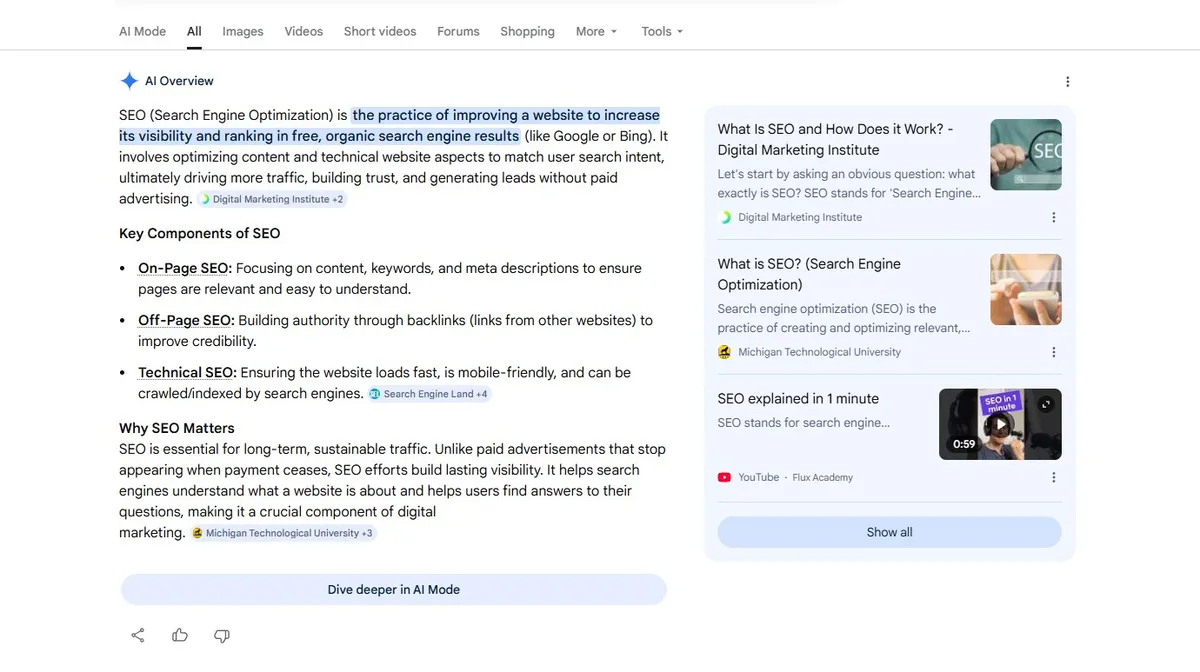
An AI Overview is a synthesized summary generated by Google’s Gemini model from multiple source pages. It appears at the top of search results, before position 1, with expandable citations. The citations are not simply the top-ranked pages, they are the pages whose content the AI could most cleanly extract to construct a coherent answer.
This distinction matters enormously. A page can rank position 1 organically and still not be cited in the AI Overview if its content is not structured for extraction. Conversely, a page ranked at position 6 or 7 can appear in the AI Overview if it contains clearly labeled, directly answerable content that the higher-ranked pages do not.
Three things determine whether your page gets cited:
- Extractability, Can the AI pull a clean, direct answer from your page without ambiguity?
- Structural alignment, Does your page use the same taxonomy and terminology the AI Overview uses?
- Entity completeness, Does your page cover all the concepts and terms associated with the topic?
None of these are about writing quality. They are about structure, the same structural decisions that determine traditional ranking, mapped against the new layer of AI extraction. Our study of 6,889 ranking pages documents the structural baseline; the GEO action items below extend that baseline for AI citation eligibility.
The GEO Audit: 8 Actions That Determine AI Citation Eligibility
GEO (Generative Engine Optimization) is the practice of structuring content to earn citations from AI systems. The following eight actions are ranked by impact, high-priority items first.
1. Mirror the AI Overview’s taxonomy in your H2 structure
AI Overviews are structured. For “search engine optimization examples,” the AI Overview presents distinct labeled categories: On-Page SEO Example, Local SEO Example, Technical SEO Example, Image SEO Example. A page that uses those exact headings, not paraphrases, not clever rewrites, is structurally positioned for citation.
Before you write or revise any article targeting a keyword with an existing AI Overview, search the keyword, expand the AI Overview, and note every category label it uses. Those labels should become your H2 headings, written as close to verbatim as the content allows.
Why this works: AI systems extract content from pages that match their internal schema for the topic. A page that uses the same terminology the model was trained on, or the same terminology the current AI Overview uses, is easier to extract from and more likely to be cited as a source.
2. Add a definition block in the first 150 words
Every article targeting a definition or informational query should have a bolded 1–2 sentence definition of the primary topic within the first 150 words. This is the most universally cited structural pattern across AI Overview sources.
The definition should be direct and freestanding, meaning it should make sense if pulled out of context and read on its own. “A content brief is a pre-writing document that specifies the topic, audience, structure, and keyword requirements for a piece of content before writing begins” is extractable. “When you think about content briefs, it’s important to understand what they actually do” is not.
Immediately after the definition, add a bulleted or numbered list. AI systems strongly prefer list-format answers for overview-type queries and frequently cite the first structured list that follows a definition.
3. Write H2 and H3 headings as questions
Headings written as questions are the structural format AI systems extract from most readily for FAQ-style queries. “How Does Local SEO Work?” is more extractable than “Local SEO Mechanics.” “What Is a Content Brief?” is more extractable than “Content Brief Overview.”
This does not mean every heading must be a question. Use question-format H2s and H3s for sections where the query is definitional or how-to. Use statement-format headings for example sections, templates, and comparison sections where the question format would be awkward.
4. Implement FAQPage schema
FAQPage schema markup explicitly tells Google which sections of your page are questions and which are their corresponding answers. For pages with a dedicated FAQ section, or for pages where H3s are written as questions with direct answers, FAQPage schema is one of the clearest signals a page can send to AI crawlers.
The schema does not need developer implementation in most modern CMS platforms. WordPress with RankMath or Yoast, Webflow, and similar tools handle FAQPage schema through the editor. What matters is that the question and answer in the schema match the question and answer on the page exactly.
5. Expand your entity footprint
AI systems evaluate topical completeness by checking whether a page mentions, defines, and contextualizes the entities associated with its topic. An article about on-page SEO that never mentions title tags, meta descriptions, H1 tags, or URL structure is topically incomplete in the model’s evaluation, even if the article is well-written and accurate.
The fix is deliberate: for every major article, identify the 6–10 entities (concepts, tools, terms, named processes) most closely associated with the topic. Explicitly define each one at the point in the article where it is most relevant. Link each entity definition to its own dedicated page if one exists on your site.
This is not keyword stuffing. It is the difference between a page that mentions SEO and a page that demonstrates genuine expertise about SEO by covering its full conceptual scope.
6. Add before/after comparison blocks
For example-driven content, before-and-after comparison blocks are one of the most extractable formats for AI systems. A side-by-side showing an unoptimized title tag versus an optimized one, with the specific change labeled, is a concrete, citable data point. A paragraph explaining that “title tags should be improved” is not.
Before/after blocks should be formatted consistently: label the “before” state, label the “after” state, and add a one-sentence annotation explaining what changed and why. This format mirrors the structure AI systems use when generating comparison answers.
7. Signal freshness with a visible update date and changelog
AI systems that weight recency, and Google’s does, for queries where freshness matters, use visible date signals on the page itself, not just metadata. For competitive informational articles, add a “Last Updated” date prominently near the article header. For articles that are regularly refreshed, a brief changelog section (“Updated March 2026: Added AI-era SEO example”) signals ongoing maintenance.
Pair this with Article schema that includes a dateModified property. The combination of visible on-page date + structured data date is more authoritative than either signal alone.
8. Build community signals through forums and discussion platforms
AI Overviews increasingly cite discussion-format content from Reddit, Quora, and industry forums, particularly for queries where the AI Overview itself contains a “discussions and forums” feature. Publishing a detailed, value-first response on r/SEO or r/Entrepreneur that references your article (without being a raw link drop) generates both referral traffic and the type of community engagement signal that AI systems interpret as real-world validation.
This is not a substitute for structural content improvements, it is a distribution amplifier that works once the page is already optimized for extraction.
How to Audit Your Own Content for AI Overview Readiness

Run this audit on any article that targets a keyword with an existing AI Overview.
Step 1: Check citation status
Search your target keyword in an incognito window. Is an AI Overview present? If yes, is your page one of the cited sources? If you are cited, you are done, monitor for changes. If you are not cited, continue.
Step 2: Map the AI Overview taxonomy
Expand the AI Overview and write down every label, category, and term it uses. These are the structural elements your page needs to mirror. Create a checklist: does your page have a section for each category the AI Overview covers?
Step 3: Check extractability of the opening
Read only the first 200 words of your article. Does it contain a bolded definition of the primary topic? Is there a list within the first 200 words? If you removed everything after the second paragraph, would a reader have a clear, complete answer to the primary query? If not, the opening needs restructuring.
Step 4: Audit heading formats
List every H2 and H3 in your article. How many are written as questions? For an informational article, at least 40% of your H3s should be in question format. If your headings are all statements, you are missing AI extraction opportunities. The right source for these question-format headings is not a keyword tool, it’s the PAA block, related searches, and autocomplete results Google is surfacing for your target query. These are the zero-volume queries that keyword tools report as having no demand, but that Google is actively routing real users through.
Step 5: Check schema implementation
Use Google’s Rich Results Test on your URL. Is FAQPage schema present if you have a FAQ section? Is Article schema present with a dateModified property? Is HowTo schema present if your article has numbered steps? Missing schema is a fixable gap that directly affects AI crawler behavior.
Step 6: Identify missing entities
Search your primary keyword in Wikipedia and read the first two paragraphs. Every concept mentioned in those paragraphs that is not mentioned in your article is a potential entity gap. Add definitions for any missing entities that are genuinely relevant to your article’s scope.
AI Saturation Levels and What They Mean for Your Strategy
Not every keyword has the same AI Overview situation. Before optimizing, assess the saturation level:
High AI saturation
The AI Overview is comprehensive, well-structured, and already cites 5+ authoritative sources. For these queries, the path to citation requires being significantly better than the current cited sources, more complete entity coverage, more specific examples, more recent data. High saturation topics are worth targeting but require more investment.
Medium AI saturation
The AI Overview exists but is thin, it covers 2–3 sub-topics when 5–6 exist, or its cited sources are generic. This is the highest-opportunity tier. A well-structured article that covers the full scope of the topic can displace thin sources within 60 days of the structural changes above.
Low or no AI saturation
No AI Overview exists, or it appears inconsistently. For these queries, publish content structured for AI extraction now, before the Overview becomes established. Being the first well-structured, citable source for a query that AI Overviews are beginning to cover is significantly easier than displacing an established source later.
Frequently Asked Questions
What is GEO and how is it different from SEO?
GEO (Generative Engine Optimization) is the practice of structuring content to earn citations from AI systems, Google AI Overviews, ChatGPT, Perplexity, and similar. SEO focuses on earning organic rankings in traditional search results. The structural requirements overlap significantly (both reward clear definitions, question-format headings, and schema markup), but GEO adds specific emphasis on entity completeness, taxonomy mirroring, and extractable answer blocks that traditional SEO does not require. For readers evaluating which content tools embed GEO guidance into brief generation (vs. treating it as a post-publish audit), the Frase alternatives comparison covers this gap specifically.
Does being cited in an AI Overview increase traffic?
It depends on the query. For queries where the AI Overview answers the question completely, some users do not click through, which is a zero-sum outcome for traffic. For queries where the AI Overview covers the topic partially and users want more detail, cited sources often see higher-quality traffic with better engagement metrics. The strategic goal is citation for two reasons: protection against traffic loss and access to higher-intent clicks from users who have already consumed the overview and want depth.
How often do AI Overview citations change?
Frequently, more frequently than organic rankings. AI Overviews update as Google’s model is refreshed and as new content is indexed. A page that is not cited today can be cited within weeks of structural changes. A page that is currently cited can be displaced if a competitor publishes more comprehensive, better-structured content on the same topic. Monitor citation status monthly for competitive keywords.
Does page speed affect AI Overview citation eligibility?
Indirectly. Google’s core ranking signals (including Core Web Vitals) affect whether a page is indexed and how frequently it is crawled, which affects how quickly structural changes are recognized. A page with poor Core Web Vitals may be crawled less frequently, meaning GEO optimizations take longer to register. Fix Core Web Vitals as a baseline, but do not treat it as the primary GEO lever.
How do I lock GEO requirements into the brief instead of treating them as a post-publish audit?
Build them into the SEO content brief alongside keyword placement and outline structure. Schema requirements, entity coverage, taxonomy mirroring, and definition-block placement are all structural decisions, they belong in the same document the writer executes from. BriefWorks generates GEO action items as a brief output, not as a separate dashboard.