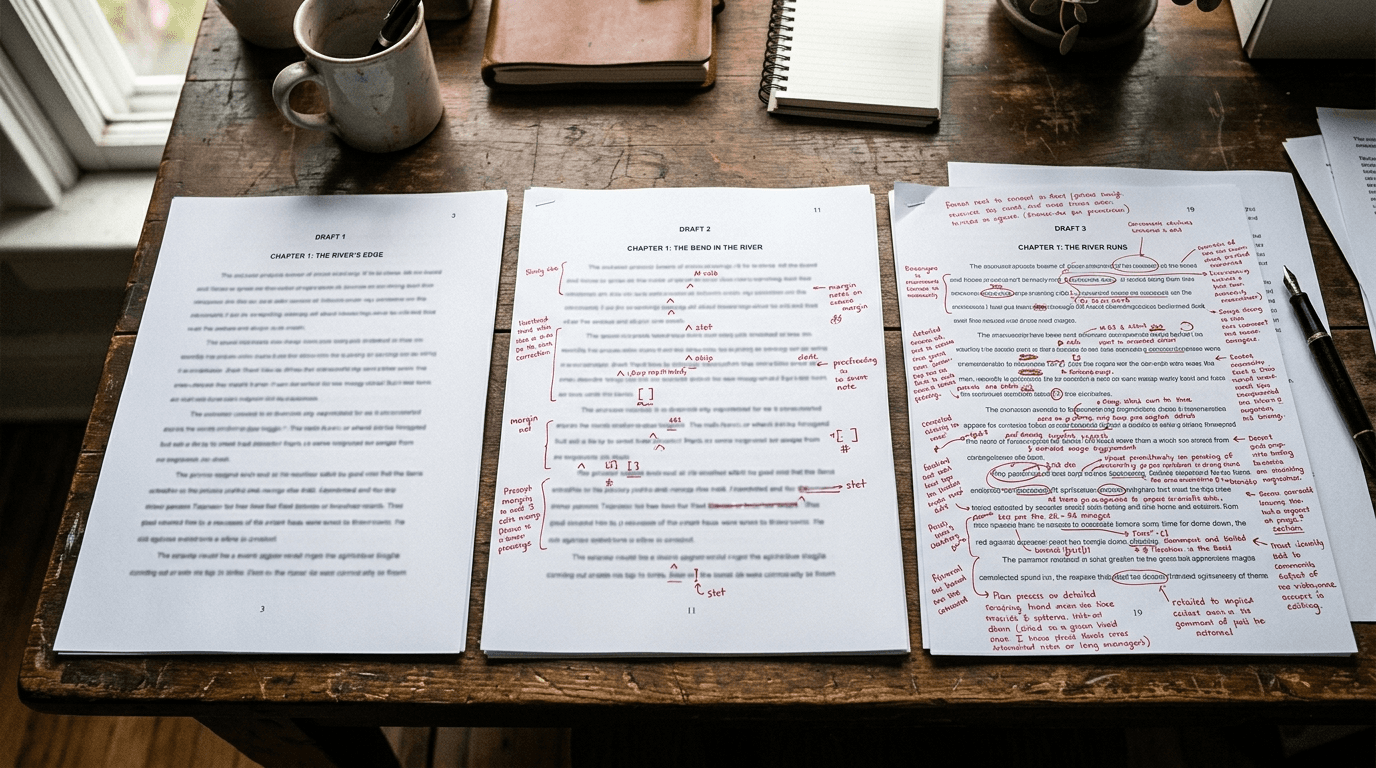
Every AI-generated article you’ve read used at least one of these: “leverage,” “paradigm shift,” “it’s worth noting,” “I’ll be transparent.” Some use all four in the same paragraph. The failure isn’t that these are inherently bad phrases. The failure is that their density in a given draft is a statistical fingerprint of machine generation.
Human writers use them occasionally. AI-generated text uses them per section, systematically, because the training process that made these models good at writing also pulled them toward the same default register. The mechanism is post-training alignment. The symptom is a list of phrases. This post covers both.
Why every major model defaults to the same register
Large language models are post-trained using feedback from human raters, the process formalized in the 2022 InstructGPT paper (Ouyang et al., trained on approximately 295,000 human comparisons) and adopted in some form by every major lab since. Those raters scored output quality across thousands of generations. Certain prose patterns scored consistently higher: clear topic sentences, forward-moving transitions, hedged assertions paired with importance framing, simulated transparency markers.
Those preferences became each model’s default register. Not a style the model chose, a weight in its parameters, as invisible to the model as a reflex is to the person who has it.
The result: Claude, GPT-4, and Gemini share a common baseline that human raters, in aggregate, preferred. They all sound similar because they were all trained toward the same human-preference signal. (The preference data has since updated across model generations, the register patterns are stickier than the version numbers suggest.)
This is also why self-review doesn’t fix the problem. A model cannot detect its own tells because those tells are its training distribution. When you ask Claude to identify AI-sounding prose in its own output, it evaluates against an internal sense of normal, and its internal normal is exactly what reads as AI-generated to an experienced reader. You would need a model trained to recognize Claude’s specific defaults as unusual. Claude doesn’t have that frame. It is that frame.
The “just tighten the persona spec” recommendation is directionally correct. It doesn’t fix the underlying register problem. A persona specification modifies surface behavior. The base register reasserts past roughly 1,500 words, where the model’s pre-training weights begin to dominate the persona constraint. That’s not a spec failure, it’s a generation-length threshold effect that appears regardless of how detailed the spec is.
The four categories of AI register tells
Our banned-phrase filter, built from production article generation logs, adversarial review runs, and cross-model comparison, groups these tells into four categories. They aren’t subjective judgments about “bad writing.” They’re phrases with measurable over-representation in AI-generated prose relative to human editorial content. (Comparison set: our own generation output vs. top-10 SERP results for matched keyword sets. Not a public dataset, but the pattern holds across every topic cluster we’ve tested.)
Category 1: Corporate-cliché vocabulary
Migrated from earnings calls and PR copy, where they signaled forward momentum to institutional audiences. In editorial prose they carry no information, they’re statistical associations from training on business documents.
leverage • leverages • leverage the • paradigm shift • game-changer • cutting-edge • state-of-the-art • seamlessly • robust solution • transformative • spearhead • unlock the potential • unlock the power of • unleash
“This tool seamlessly integrates with your workflow” contains zero data points. No integration timeline, no system requirements, no failure modes, just a motion-gesture dressed as a claim. These words appeared at high rates in the training corpus (business documents, LinkedIn posts, tech PR) and were reinforced by raters who scored confident-sounding output positively. The model learned that they belong in professional writing. They do. So does every other piece of professional writing, which is why they read as generated.
Category 2: Scope inflation
Words that gesture at volume without naming it. They function as hedges disguised as abundance claims.
a wide range of • a myriad of • plethora of • tapestry of • comprehensive guide • a deep dive
“A wide range of industries use this approach” is a knowledge gap pretending to be breadth. A writer who knows which industries use it names them. Scope inflation is the model’s way of appearing thorough without being specific, reach for an abundance marker when the concrete example isn’t available. “Comprehensive guide” belongs here too: it promises exhaustiveness that the article’s actual content almost never delivers.
Category 3: Hedge and prominence markers
These phrases do two incompatible things simultaneously: they flag the upcoming sentence as important, and they hedge it. “It’s important to note that X” says X is worth noting while distancing the writer from X. Confident prose doesn’t hedge claims with importance markers. It makes the claim.
it’s worth noting • it’s important to note • it’s important to remember • when it comes to • in conclusion • ultimately, • at the end of the day • in the realm of • navigating the complexities • navigating the landscape
“Navigating the landscape” is the most diagnostic case. It sounds like a strategic metaphor but describes nothing. Navigating toward what? From where? The phrase fills the space a real observation would occupy and substitutes a motion-gesture for an analysis. “When it comes to X” is the structural equivalent: it opens a clause that could open with X directly, inserting five words that add no meaning.
Category 4: Simulated-candor hooks
The most telling category, and the one that appears most often in recent model outputs because it operates at a higher register than cruder tells.
I’ll be transparent • I want to be honest • I’ll say this upfront • to be honest with you • let me be honest • I’ll level with you • real talk • I’ll tell you straight • truth be told
These phrases announce that the writer is being honest, something an honest writer would never need to announce. Honest prose demonstrates candor through specificity and disconfirmable claims. The simulated-candor construction says the quiet part loudly and leaves the actual content vague. It’s what you write when you want credit for transparency without naming the specific limitation or uncomfortable fact.
These are a direct post-training artifact: raters rewarded output that appeared conversationally warm and forthcoming. Models learned to perform honesty with framing markers rather than demonstrate it with content. In our adversarial cross-model testing, Gemini flagged simulated-candor constructions in 3 of 4 outputs that Sonnet’s self-review had returned clean. Sonnet produced them and didn’t flag them because, from Sonnet’s perspective, they read as natural transparency moves. They are natural, for Sonnet. That’s the problem.
Grand-openers and journey metaphors: section-level padding
These function as opener padding, they let the model begin a section without committing to a claim. Any sentence that starts with one of these phrases could have started with the actual claim instead.
in today’s fast-paced world • navigating the landscape • the world of • delve into • let’s dive in • dive deep into • embark on • embark on a journey • rapidly evolving • ever-evolving
The opener pattern is the giveaway: it asserts environmental urgency (“fast-paced”) or intellectual depth (“deep dive”) before committing to any specific information. Remove these phrases and the sentences that follow them almost always read better, the claim was always there, it just had five words of staging in front of it.
Journey metaphors (“dive into,” “embark on”) are borrowed from workshop writing instruction manuals. In business editorial they mark the start of a section the writer hasn’t yet decided how to open. The “dive” cluster appears with particular frequency in AI output, probably because it appears with frequency in the instructional writing that models trained on, which is itself a corpus of people explaining how to write.
Why phrase removal isn’t the whole answer
The “just ban the phrases” advice is correct as a first pass. The “ban the phrases and the problem is solved” version of that advice survives because it’s measurable and produces visible short-term improvement. Run the filter, get a clean result, publish. The article still reads as generated.
What phrase filters don’t catch: structural-level generation artifacts. Uniform paragraph length. Mechanical execution of required rhetorical moves, where every example section opens with the same lead-in construction. No tangents. No off-thread observations that return to the main line. Cross-persona scaffold uniformity, different voice specifications producing documents with the same underlying structure regardless of topic or audience.
In adversarial review testing, Gemini caught 4 structural patterns across all 4 outputs that Sonnet’s self-review had missed entirely. None of the 4 were phrase-level. All were structural: mechanical cadence, structural rigidity, cross-persona uniformity, and the complete absence of tangents. One specific rhetorical move appeared in 11 of 11 consecutive section closers across the test batch, a frequency no human writer sustains. Sonnet didn’t flag it because from inside Sonnet’s distribution it read as correct execution. Gemini saw it immediately.
A published draft with a simulated-candor hook has failed a basic surface test. A draft that passes the phrase filter and still has mechanical cadence, uniform paragraph rhythms, and no narrative detours has passed the surface test and failed the structural one. Both tests are necessary. Neither substitutes for the other.
How the list was built, and why it changes
The filter didn’t come from a paper. It came from watching generated articles fail in production.
We collected output from article runs, noted which phrases experienced editors flagged on inspection, then ran adversarial critique passes using a different model family to surface tells the generating model couldn’t self-report. The first adversarial test batch produced immediate results: simulated-candor constructions in 3 of 4 outputs, phrases Sonnet had produced and not flagged in its own review because, from Sonnet’s perspective, they weren’t tells. They were normal prose. Gemini flagged all three.
That’s the calibration flywheel: adversarial pass flags a consistent tell → add it to the filter → confirm it disappears in subsequent generations → track whether equivalent phrases appear to fill the same function. The list grows through this cycle, not through editorial intuition.
The list also changes. Newer model versions learn to avoid the most flagged tells from prior generations, and higher-register equivalents emerge. The cruder simulated-candor markers are becoming less common in the latest Claude and GPT-4 outputs. Subtler versions, constructions that perform the same transparency-signaling function while reading more naturally, are already appearing. A phrase filter that hasn’t been reviewed in 12 months is calibrated to catches from 12 months ago.
This is the same dynamic that makes SERP structure shift faster than annual content strategies can follow: the target isn’t fixed, and treating it as fixed produces strategies that were correct 18 months earlier. Quarterly review is the minimum defensible cadence for a phrase ban list; after major model releases, sooner.
The article as the test
None of the catalog phrases above appear in the prose sections of this article. That’s a verifiable claim. Our filter runs programmatically on every article BriefWorks generates before publication, the phrase list is the gate the output must clear. This article was written to the same standard the filter enforces.
The reason this matters beyond quality signaling: experienced practitioners in any field have absorbed enough editorial content to notice the register shift, even when they can’t name it. They may not write a complaint. They disengage. That disengagement registers in the behavioral signals that determine AI Overview citation eligibility, time on page, scroll depth, return rate. A draft that fails on register fails on attention before it fails on rankings.
The phrase list is the start of the diagnostic. The structural work, cadence variation, mandatory rhetorical moves that differ in execution rather than just in presence, tangents that demonstrate a human wrote this and got distracted, is the harder layer. Both are necessary. Start with the phrases because they’re fast, measurable, and catch the most egregious failures. Don’t stop there.
Frequently Asked Questions
Can AI detection tools catch these tells automatically?
AI detection tools (GPTZero, Turnitin’s detector, Copyleaks) score the probability that text was machine-generated using perplexity and burstiness metrics derived from token distributions. They don’t specifically scan for phrase-level register markers, they measure statistical smoothness. A phrase filter and a detection-tool score are complementary, not redundant: the filter catches register markers that a smoothness metric would miss; the smoothness metric catches structural generation artifacts the phrase list can’t see. Running both and reconciling the results gives you the more complete picture.
If you strip all these phrases, does the article automatically sound human?
No. Phrase removal is necessary and insufficient. After removing the surface tells, structural artifacts remain: mechanical paragraph-length uniformity, repetitive section-opening cadences, no tangents, no off-thread observations that return to the main thread. Human writing has texture at the structural level that phrase removal doesn’t create. You need both: phrase-level filtering and structural-level variation through persona specifications with concrete rhetorical actions that differ in how they’re executed, not just whether they appear.
Do Gemini and GPT-4 have different tells than Claude?
Yes, and that divergence is what makes adversarial cross-model review useful. Gemini has its own tell set: flatter sentence rhythm, heavier use of explicit logical connectives (“This means that…”), more frequent enumeration even for non-list content. GPT-4 has different corporate-vocabulary preferences and a different simulated-candor pattern register. The tells overlap at the most egregious end of each category and diverge at the middle register. Gemini is a useful adversarial reviewer precisely because it doesn’t share Claude’s specific defaults, what reads as normal output to Claude reads as a tell to a model trained on a different corpus.
Does this phrase list change over time?
Yes. Newer model versions learn to avoid the most flagged tells from prior versions, and subtler equivalents appear to fill the same functional role. The crudest simulated-candor markers are already declining in frequency across the latest model outputs. Quarterly review of the phrase filter is the minimum defensible cadence. After major model version releases, run an adversarial review pass on recent drafts, this surfaces new patterns faster than observation alone can catch them.
Why do models from different companies use the same phrases? They’re separate products.
Because the human-preference signals that shaped each model’s post-training were drawn from evaluators who share tacit preferences about what reads as “good writing”, preferences formed by the same underlying corpus of business, academic, and editorial writing. The raters at OpenAI, Google, and Anthropic weren’t coordinating. They were applying the same aesthetic formed by the same reading history. Models trained by different labs to satisfy similar raters end up with similar default registers. The phrase-level overlap is downstream of the evaluator-preference overlap. Same training target, same output distribution. The multi-vector probing that AI search applies to your content when deciding citation eligibility operates on the same adversarial-coverage principle, different evaluation angles checking whether the same document resolves different facets of a query.